"What should I prepare for Children's Day meals?"
Searching on your smartphone while thinking this, you must be a mother who, despite the busyness of daily life, wants to properly celebrate your child's growth, right?
In this article, we will gently introduce the meanings of traditional Children's Day foods and offer tips for incorporating them into your meals without stress, even with a busy schedule. In the latter half of the article, we also interviewed Ms. Minori Sugiyama, a registered dietitian, about "How should we approach Children's Day meals?"
Ms. Sugiyama is a registered dietitian who teaches cooking and baking at a vocational support center in the Kusanagi area of Shizuoka City. She previously worked at a long-established diner in Shizuoka, where she witnessed many moments where
What Ms. Sugiyama wants to convey is that the Children's Day table doesn't have to be perfect. 👍
Kashiwa mochi and chimaki, eaten on Tango no Sekku (Boys' Festival), are imbued with the wish for a child's healthy growth. However, simply knowing that meaning is enough. If you know it, you can tell your child a word or two when you serve store-bought kashiwa mochi at the table. That alone can turn a simple meal into a celebration.
Let's find a way to celebrate that's unique to our family.
What does it mean to celebrate in our own way?
As Children's Day approaches, social media is flooded with photos of elaborate dishes and festive decorations, isn't it? I understand the feeling of thinking, "I have to do this much too."
But, please stop for a moment and think. Who are the celebrations for Tango no Sekku (Children's Day) for?
It's a day to celebrate your child's growth. That's the meaning of the holiday on May 5th. What's important is that your child is smiling on that day. And that you, the mother, can also be in a calm state of mind. 😊
Prioritize "fun" over "having to do it properly."
When Ms. Sugiyama worked at a nursing home, she sometimes asked the residents, 'What was Children's Day like in the old days?' The answers were surprisingly simple: 'We ate kashiwa mochi,' 'We took an iris bath,' 'We looked up at the koinobori (carp streamers)'—memories like these were common.
There aren't many stories about elaborate cooking. However, memories like "Mom bought kashiwa mochi" or "We all ate it together" remain even after decades. The scene of the dining table itself is etched in our hearts.
So, you don't have to push yourself by thinking, "I have to do it properly." Just because it's a traditional event doesn't mean you have to do something special. Creating a time that the child feels was "fun." Isn't that our family's way of celebrating?
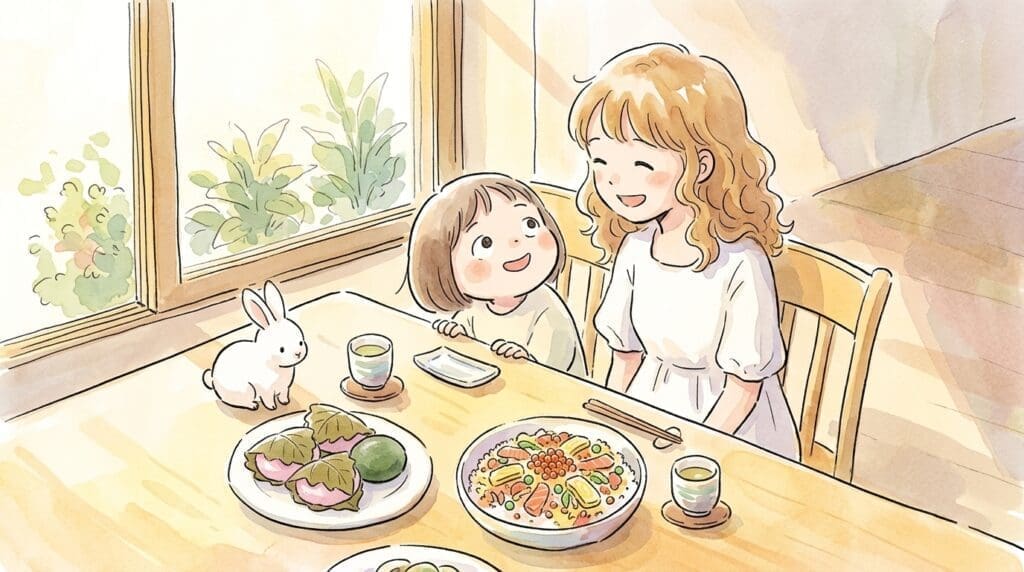
A dining table where children are happy is a dining table where mothers can smile
When Ms. Sugiyama worked at a long-established diner, a regular customer said something like this: "I remember the face of the person who made the food more than the taste of the food."
It might be the same for children. A simple meal served with a smile and
Knowing the meaning behind Children's Day foods can relieve some of the pressure to "prepare this." If you know the meaning, anything you choose becomes a "celebration." The time spent saying "This is delicious" with family is far more important than perfectly preparing auspicious foods.
A table where the mother is smiling might be the best feast for a child.
Children's Day table ideas that are easy to incorporate even on busy days
Even though it's Golden Week, you might have work or a mountain of housework. It's tough to prepare for celebrations when you're busy, isn't it?
Here, we introduce simple ideas that can create a "celebratory feeling" without overdoing it. You don't have to do everything. Try just one thing that seems feasible.
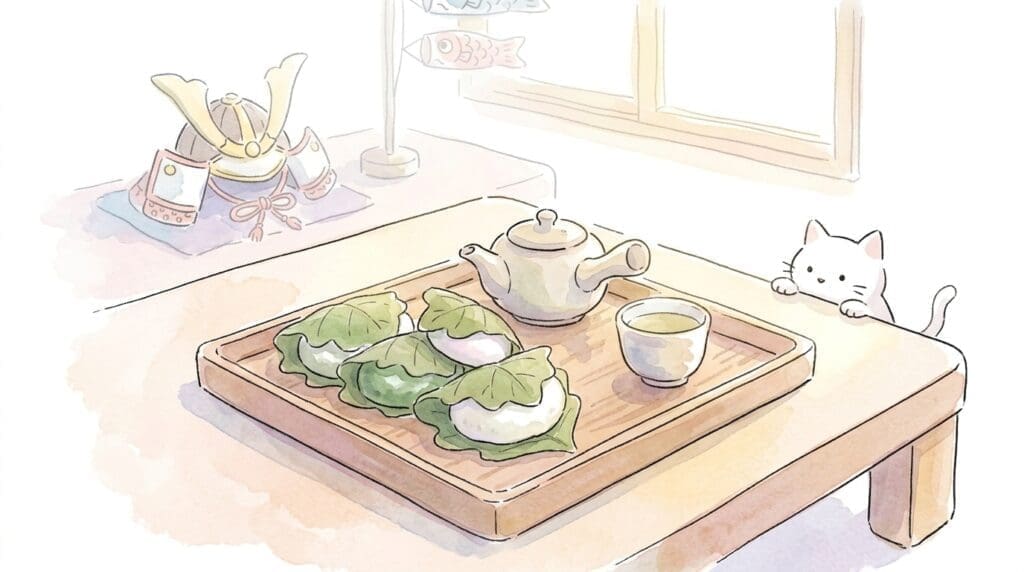
Simply placing Kashiwa mochi from the supermarket on the table is a splendid celebration.
Do you think, "I have to make kashiwa mochi from scratch"?
Arrange the kashiwa mochi bought from the supermarket or convenience store on a plate. That's enough. Kashiwa mochi is a traditional Japanese confection and a standard food eaten on Tango no Sekku (Children's Day). Even if you buy it, its meaning doesn't change.
What's important is to add a word when you serve it, like, 'This is a Children's Day treat.' Children sense that it's different from usual. That becomes a memory of celebration.
Smelling the scent of the kashiwa leaf, or lifting the leaf to show the mochi. Such small interactions can also lead to food education. 🍃
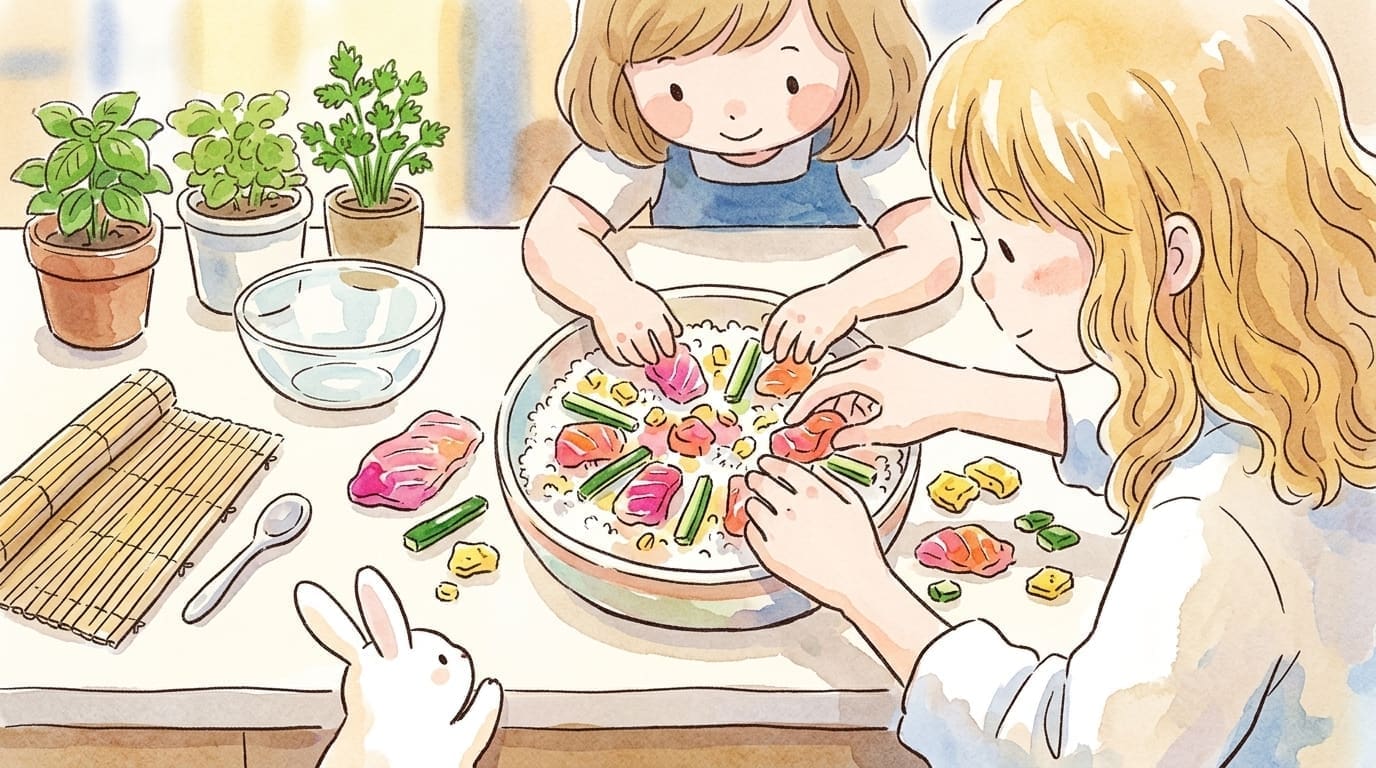
Easy and popular chirashizushi that you can make with your children.
Chirashizushi is a popular dish not only for Children's Day but also for events like Hinamatsuri. Its festive appearance is also a hit with children.
However, making it from scratch is difficult. For that reason, we recommend using a store-bought 'chirashizushi mix.'
You can make sushi rice just by mixing it into the rice. Then, just top it with things you have at home, like kinshi tamago (shredded egg crepes), cucumber, or ham. If you let children choose and place their favorite toppings, they'll happily help.
Ms. Sugiyama saw a scene at a friend's house where a 3-year-old was earnestly arranging kinshi tamago (shredded egg omelet), and the resulting chirashizushi was quite messy (laughs). But the child ate it proudly, saying, "I made it myself."
The experience of "making it together" is more important than the appearance. Even if you're busy, try letting your child handle just the topping part. 😊
Bamboo shoot rice cooked in a rice cooker
Bamboo shoots are a seasonal ingredient that reaches its peak during Children's Day. Because they grow straight towards the sky, they are considered an auspicious food symbolizing wishes for a child's growth.
However, preparing fresh bamboo shoots can be a lot of work, right? Using boiled bamboo shoots makes it easy to create bamboo shoot rice.
Cook rice with boiled bamboo shoots (cut into thin strips), soy sauce, mirin, and dashi broth, then press the start button on your rice cooker. Once cooked, top with snow peas or chopped nori seaweed for a more festive look.
"Today we have bamboo shoot rice. Grow up strong like a bamboo shoot!" — Adding a simple phrase like this is enough to make a wonderful Children's Day table. 🎋
Let's learn the origins of the traditional foods eaten on Children's Day.
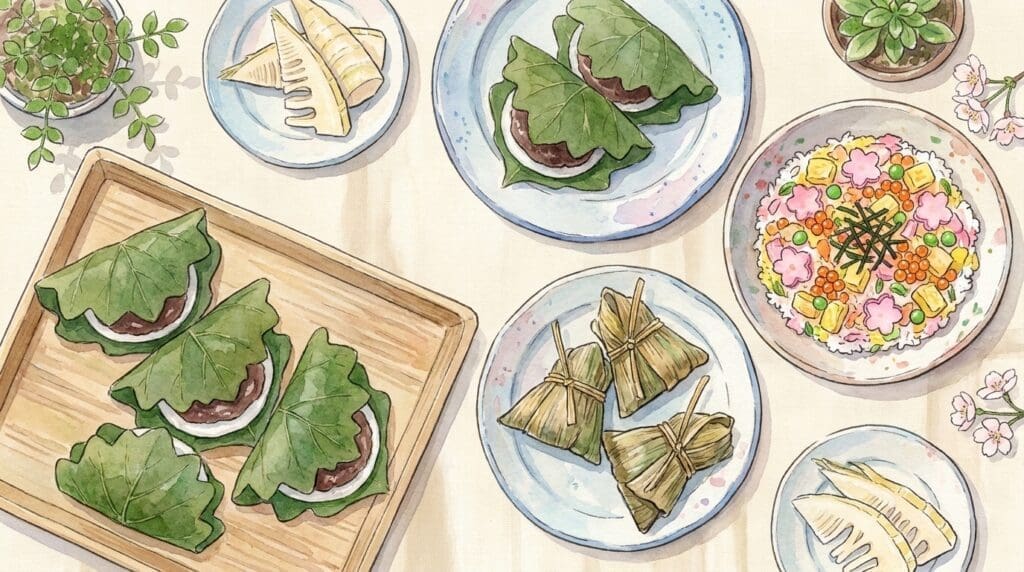
Children's Day foods each have their own origins and wishes associated with them. You don't need to remember them all. However, if you can answer even one question when your child asks, "Why do we eat this?", your mealtime will become richer.
Here, we will gently introduce the traditional foods eaten on Tango no Sekku (Children's Day).
The Wish for "Prosperity of Descendants" Enshrined in Kashiwa Mochi | Traditional Japanese Confectionery
Kashiwa mochi is a Japanese confection wrapped in a kashiwa leaf. It is filled with red bean paste or miso paste.
The Kashiwa tree has the characteristic that its old leaves do not fall off until new buds appear. This is associated with the meaning of "parents protecting their children until they are born," and it has been considered an auspicious symbol for the prosperity of descendants.
This custom is said to date back to the Edo period and is a standard celebratory food, especially in the Kanto region.
Mr. Sugiyama heard a story from one family: when the mother told her child, "You know, the kashiwa leaves don't fall off until new leaves emerge. It means we wish for you, [Child's Name], to always be healthy," the 3-year-old child replied, "Mommy, I wish for you to be healthy forever too."
The time spent exchanging words with your child over kashiwa mochi may be giving them something far richer than nutrition.
The Origin of Chimaki Being Eaten on Tango no Sekku | Culture on May 5th
Chimaki is a food made by wrapping glutinous rice in bamboo or kaya grass and steaming it. It originated as a custom from ancient China, said to have begun when sticky rice dumplings were thrown into the river to mourn the poet Qu Yuan during China's Warring States period.
It was introduced to Japan in the Nara period and became established as a seasonal food eaten on Tango no Sekku. The belief was that bamboo leaves have the power to ward off evil, and it carries the wish to protect children from illness and disaster.
Chimaki is often eaten mainly in the Kansai region, while kashiwa mochi is popular in the Kanto region. Whichever you eat, the wish for the child's healthy growth is the same.
You can choose based on your region or your family's preferences. 👍
The auspicious meanings of chirashizushi and bamboo shoot dishes | Important family events
Chirashizushi and bamboo shoot dishes are standard celebratory foods, not just for Children's Day.
The ingredients used in chirashizushi each have auspicious meanings.
- Shrimp: To live a long life until your back is bent
- Lotus root: So that you can see the future (because it has holes)
- Beans: So you can work diligently
Also, bamboo shoots are considered an auspicious symbol for wishing for growth. Their straight upward growth is associated with the healthy growth of children.
Dishes using "shusse-uo" (fish that change names as they grow) like yellowtail or bonito are also suitable foods for Tango no Sekku. Shusse-uo are fish that change their names with growth, symbolizing the celebration of a child's success and growth. 🐟
There's no need to prepare all these foods. Even having just one on the table creates an atmosphere of "today is a special day." Please enjoy it to the best of your ability as an important family event.
Gentle words to children about the meaning of food.
The foods for Tango no Sekku each carry a wish. But when you convey the meaning to your children, you don't need to overthink it.
More than "This is lucky" or "It's an old custom," simpler words are enough.
Expressing gratitude with words: "I hope you grow up big and strong."
Children's Day is a day to respect children's personalities and consider their happiness. When it was established as a national holiday in the "Law Concerning National Holidays" in 1948, it also included the meaning of "a day to thank mothers."
So, on Children's Day, try telling them, "You've grown so much," and "Thank you for staying healthy."
Say "Stay healthy forever" when eating kashiwa mochi. Say "Grow up quickly like a bamboo shoot" when eating bamboo shoot rice. That alone is enough to convey the feeling of "wishing for growth" embedded in the food to your child. 💖
The nutritional and historical explanations can wait until the children are a little older. For now, try to focus on expressing your feelings in words, such as "I'm so happy you're healthy and well."
Traditional events can be started by simply "learning" about them.
May 5th was originally Tango no Sekku, a day to celebrate the growth of boys. There are traditional ways to celebrate, such as decorating with helmets and May dolls, flying carp streamers, and taking iris baths.
However, you don't need to do everything perfectly. ✅
If your child asks, "Why do you put leaves in the bath?" you can answer, "It's a leaf called Ayame with a strong scent that's said to make you feel energetic." If they ask, "Why do you decorate with carp streamers?" you can answer, "Carp are strong fish and can even swim up waterfalls. It means we wish for you, [Child's Name], to become strong too."
Traditional events are enough if you "know" about them. If you know, you can tell your children. By telling them, the event gains meaning. ✨
This year, just knowing "what Children's Day is about" is a step forward. Next year, you can celebrate in a different way. Just as family structures change, the way we celebrate events can also change.
We asked registered dietitian Minori Sugiyama: How should we think about the Children's Day table? 🍽️
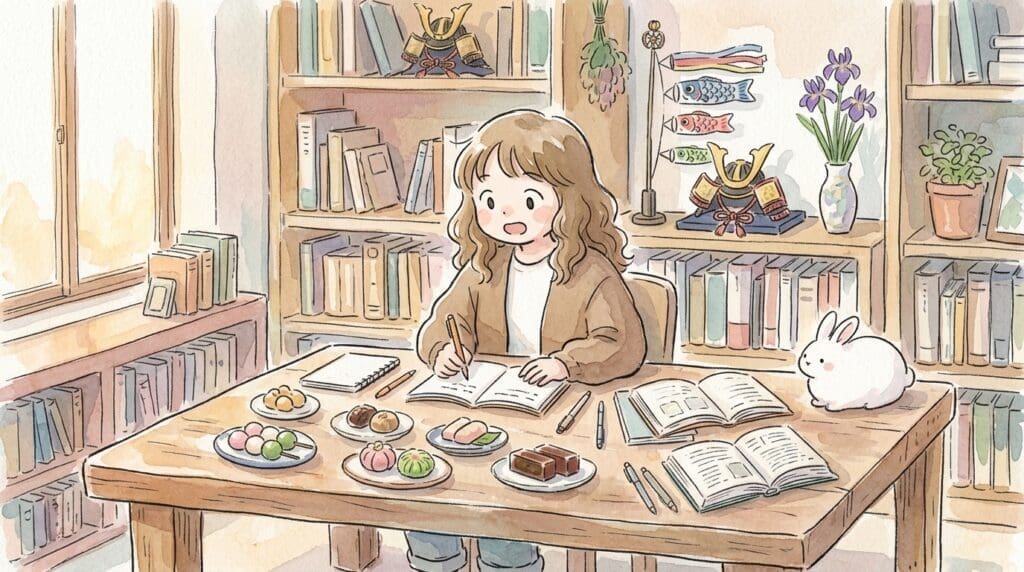
So far, we've introduced the meanings of Children's Day foods and tips for incorporating them into busy daily life. At the end of the article, we asked registered dietitian Minori Sugiyama about the Children's Day table. 👩⚕️
— Ms. Sugiyama, you sometimes receive consultations asking, "What should I feed my children on Children's Day?"
When I was actually working in the company cafeteria, I struggled to create menus that considered nutritional balance within a limited budget and time, and that people could eat without getting bored every day.
I felt that no matter how nutritionally conscious the menu I created was, the impression of the meal changed considerably depending on whether it was eaten with a smile and a "This is delicious!".
Even with dishes made with carefully prepared dashi stock, or simple dishes, if they are eaten with a smile and a "This is delicious!", the atmosphere of the place instantly softens.
It's the same for children; the feelings of their mothers and fathers are naturally conveyed during the time they spend eating together, saying "This is delicious!". I believe such times are probably what remain in their memories.
It's the same for children. The accumulation of moments where they feel "delicious" builds their confidence in food. So, before nutritional balance, what I want you to prioritize is that the dining table is a fun place.
You don't need to rush to make special dishes just because it's Tango no Sekku. Just buy one kashiwa mochi and eat it together saying, "This is delicious." That's enough. 😊
— The story about the long-established diner where you used to work is also impressive, isn't it?
At the long-established diner where I used to work, we made dashi broth using chicken bones and dried sardines. It was a lot of work, but when customers drank the miso soup made with that broth, they would say, "This tastes nostalgic." That moment was the most rewarding for me.
But you don't need to make dashi every day. Even with granules or instant dashi, if you have time to "eat together," that's enough. 😋
Children's Day foods include many auspicious items such as kashiwa mochi, chimaki, and bamboo shoot rice. Each has a meaning of wishing for growth or warding off evil spirits. Knowing this can broaden conversations at the dining table.
But you don't have to prepare everything."
— You often say that a mother's own peace of mind is also important.
"If the mother is smiling and enjoying herself at the table, the children will think, 'I want to try that too.' You don't need to make many different dishes every day. Even simple meals are enough if you have time to eat together."
Actually, I'm not able to make perfect meals either. When I get home from work and I'm tired, I sometimes rely on pre-packaged meals. Even so, we sit at the table and say, "Itadakimasu." I think that moment is enough.
Children's Day is a holiday to celebrate children's growth and thank mothers. So, mothers, please take care of yourselves too. It's okay to decide, "Today is a day not to push myself."
A fun meal remains in a child's memory more than a perfect table setting.
This Children's Day, try asking your child just one thing they like. "What do you want to eat today?" From there, many unexpected things can begin.
Eating what your child chooses together. That's how you create a Children's Day table that's unique to your family."
Conclusion
There is no single "correct" way to celebrate Children's Day with food. Whether it's Kashiwa mochi, chirashizushi, or anything else your child wants to eat, if you eat it together as a family, it becomes your family's unique celebration.
As Ms. Sugiyama said, a mother's smile is the best feast for a child. This year, please try starting with just one thing you think, "I can do this."
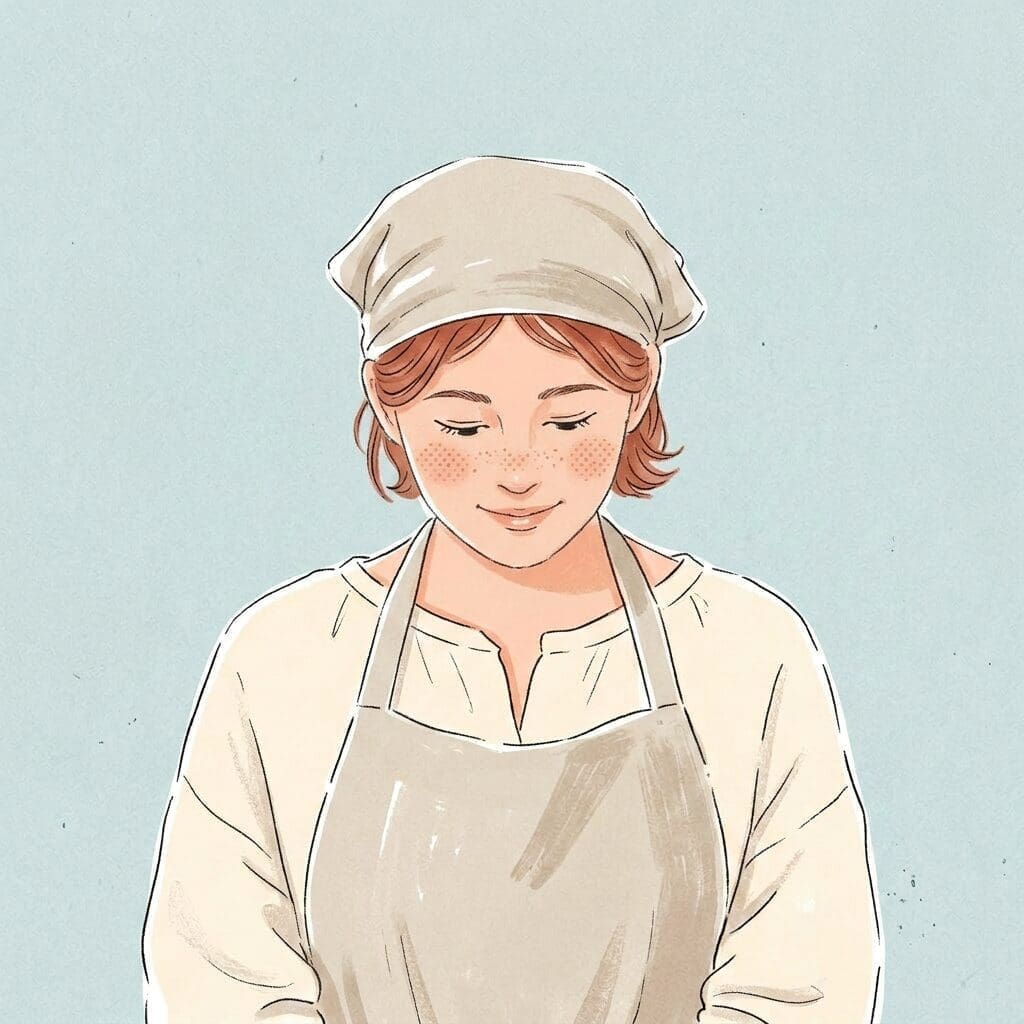
栄養士・杉山味乃里さん
A nutritionist from Shimizu City, Shizuoka Prefecture.
After being in charge of nutritional management and menu planning at the employee cafeteria of Hotel Grand Hill Shizuoka, she acquired expertise in ingredient selection and cooking techniques at the teppanyaki restaurant "Keyaki" within the same hotel.
Trained at the long-established diner "Kanbara-kan," founded in 1954, and took over management. Has experience in inheriting the traditional dashi made from chicken bones, pork bones, and dried sardines.
Currently, she teaches cooking and baking at a vocational support center in the Kusanagi area of Shizuoka City, and continues to share information on the themes of food and health, and children's food.