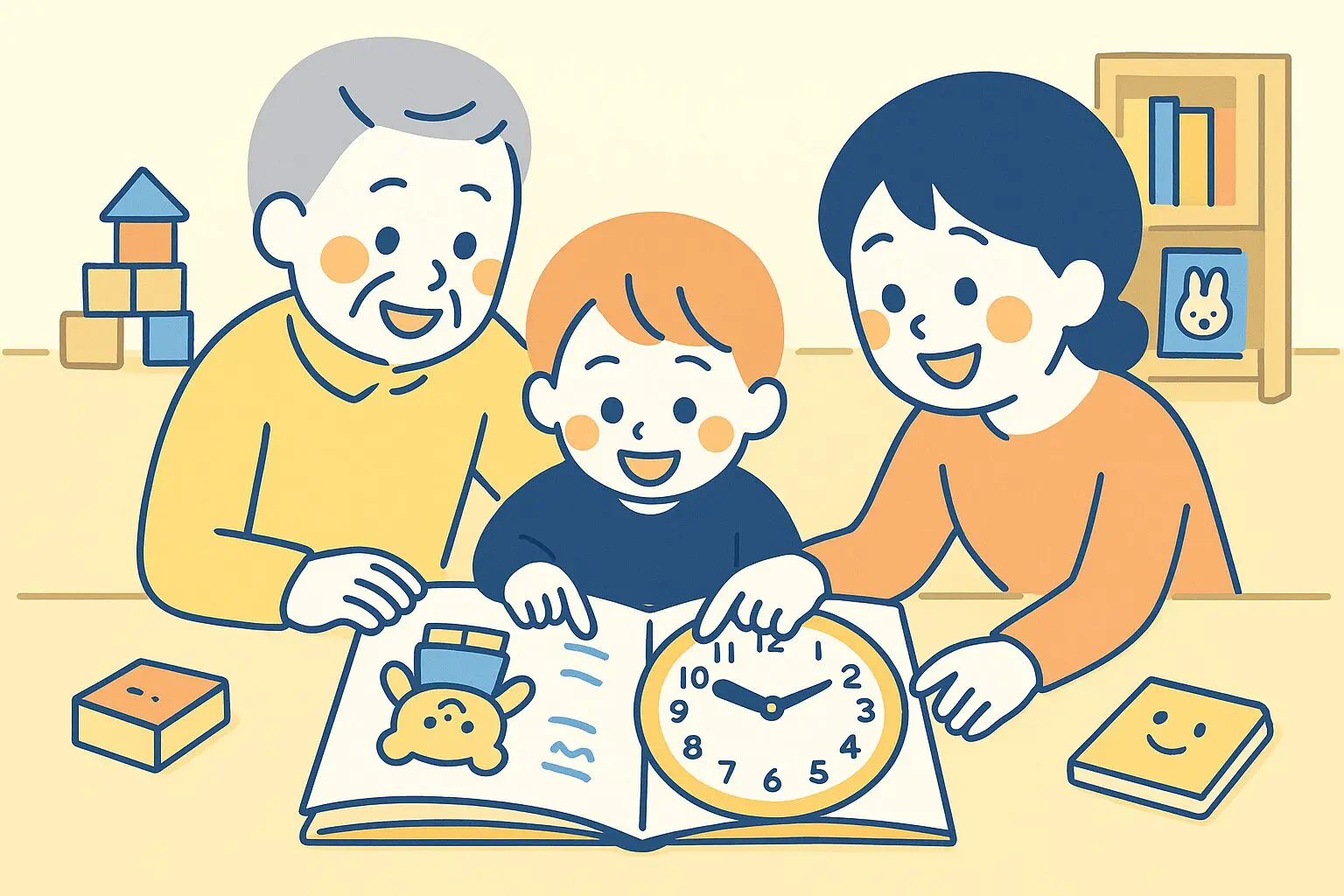
You may be wondering where to start learning your child's watch. In this article, we will summarize the perfect watch picture books for age and purpose from an expert's perspective. The conclusion to successful clock learning is to choose a book that is appropriate for your child's developmental stage. From gimmick picture books that can be enjoyed from the age of 0 to learning picture books for elementary school students, to titles of popular characters. We will also explain effective teaching methods and tips for resolving stumbling blocks, and thoroughly support you in choosing the best picture book.
The basics and developmental stages of clock learning that you need to know first
Teaching children how to read clocks takes more patience than you might imagine. The mechanism of the clock, which adults take for granted, is also full of abstract and difficult concepts for children to understand. However, If you understand your child's developmental stage and approach it at the right time, learning clocks is not difficult at all.
Full-fledged watch learning begins in the first grade of elementary school, but the reality is that there is not much time devoted to clock units at school. Therefore, support at home greatly affects the child's level of understanding. In this chapter, we will explain the basic ideas that form the basis for clock learning and children's development that you should know before choosing a clock picture book.
The Relationship Between Number Understanding and Clock Learning
In order to smoothly learn watches, a certain level of "understanding numbers" is essential as a prerequisite. Not only can you chant numbers, Sensory understanding of the meaning of numbers (sense of volume and order) is the foundation for learning about the complex system of watches.
For example, understanding the order and size of numbers, such as "3 is 4" or "8 is greater than 9", is essential for understanding the concept of the clock moving forward and the passage of time. It is important to proceed with the steps of clock learning according to the child's understanding of numbers.
The following table summarizes the developmental stages of children and the guidelines for learning watches. This is just a guideline, and please proceed flexibly according to your child's interests and development.
| Developmental stage (approximate age) | Required numerical skills | What you can do with clock learning |
|---|---|---|
| 2~3 years old | It can be counted from 1 to 10. You can see the size of a simple number. | Through picture books and characters, he became interested in the shape of the clock and the numbers on the dial. |
| 3~4 years old | You can count from 1 to 20 and read numbers. It touches the number "10" or higher. | You will be able to understand "exactly at 〇 o'clock". "When the short hand reaches 3, it's snack time," etc., and begins to connect life and time. |
| 4~5 years old | It can be counted from 1 to 30. The concept of simple addition sprouts. | You will be able to understand "〇 and a half". Understand that if the long needle points to "6", it is "half". |
| 5~6 years old | Count from 1 to 60. 5, 10, 15… It is counted as 5 jumps. | You will be able to understand the time in 5-minute increments of "〇:00". The foundation of clock learning for elementary school entrance is solidified. |

Stumbling points and order of resolution
There is a common point that many children stumble upon in learning watches. By understanding why it is difficult and why it is difficult in advance, adults can gently snuggle up to their children's "I don't know".
[Main stumbling points]
- The role of two needles: It is confusing that the short hands (hours) and the long hands (minutes) have different roles.
- Geared needle movement: It is difficult to understand the linkage between short needles moving little by little, and short needles moving forward one when a long needle goes around.
- The concept of "minutes": The biggest challenge is reading the numbers, with the "1" on the dial referring to "5 minutes" and the "2" referring to "10 minutes".
- The position of the short hand at "〇 and a half": At 3:30, the short hand is located between "3" and "4", so you may ask, "Is it 3 o'clock or 4 o'clock?" It is easy to get confused.
To eliminate these stumbling blocks, It is most effective to proceed step by step in the correct order rather than trying to teach everything at once is. Don't rush and try to clear each step.
[Recommended learning steps]
- Get Friends with Watches: First, you will become familiar with the shape and role of the clock with picture books and toys. Use fun words like "tick-tock" or "long and short needles" to pique their interest.
- Mastering "exactly at the right o'clock": We will teach from the role of a "short needle" in connection with the time that is the break in life. "If the short hand points to 8, it's time for a good night" is effective.
- Understanding "〇:30": Next, I will teach you the role of the "long needle". I remember the rule that when the long hand points to the "6" directly below, it is "half". At this time, also tell them that the short needle comes between the numbers.
- Challenge the minutes in "5-minute increments": Learning "minutes" starts in 5-minute increments. It is smooth to apply the 5 steps of the multiplication table, such as "5 minutes if the long hand points to 1, 10 minutes if it points to 2".
- Finish in "1-minute increments": Once the 5-minute increments are established, it's time to learn in 1-minute increments. While counting the fine scales together, we will complete the reading of the clock.
By proceeding in this order, children can easily absorb the concept of watches. The important thing is not to force it as a study, but to have fun working on it as part of communication in your life.

 Po Chip
Recommended watch picture books by age
It is important to choose the right picture book for the child's developmental stage when learning about clocks. If you give difficult content before you know the concept of a clock yet, you may feel that you are not good at it. Here Recommended clock picture books for each age We will introduce you to a careful selection. Please use this as a reference to find the perfect book for your child.
For 0~2 years old|Fun touch with sound and gesture
From 0 to 2 years old, Rather than "learning" how to read a clock, become familiar with the shape and sound of a clock through "play" This is the purpose. During this period, babies use their five senses to perceive the world. Therefore, we recommend picture books that have colorful illustrations, as well as sounds and "shikake" that can be enjoyed by touching them with your fingers. If it is a durable board book type, it is safe to lick or chew.
By being exposed to the motif of watches at this time, it will be an opportunity for you to become interested smoothly after the age of 3, when full-fledged learning begins.
What is the sound of the sound now?
It is supported by the mom and dad generation as an educational picture book that not only practices how to read clocks, but also allows them to naturally remember their living time and habits. There was a boom in play at one time, and there were many stories of people who developed a sense of "what time and what minute" as they moved the needle. It is especially recommended for families who are looking for a full-fledged educational effect, such as detailed needle setting and one-minute readings
 Po Chip
Kurokuma-kun's and Keiehon
"Kurokuma-kun no Tokeihon" does not have a voice function, so it is characterized by flexibility that allows parents and children to learn about watches while interacting, watch parts that are close to the real thing, and a durable design. It is recommended for learning clocks for the first time with a structure that allows you to learn naturally through play, and it is an educational picture book that is highly favored by the generation of parents who want to easily enjoy learning the KUMON method at home.
 Po Chip
For 3~4 years old|Are you moving the needle now?
At the age of 3 to 4, they can read numbers from 1 to 10 and little by little begin to understand the concept of time. During this period, While linking it with the story, you can actually move the hands of the clock. is the best. If you connect time with specific life scenes, such as "wake up at 7 a.m." or "eat at 12 o'clock," it will be easier for children to intuitively understand time.
Picture books featuring characters can bring out children's desire to know more and make them familiar with watches in a fun way.
Penelope: What are you doing now?
You can learn how to read a clock while following Penelope's daily life. It is a full-fledged hook in which the long and short hands move in conjunction, allowing you to experience how time passes.
 Po Chip
What are you really doing with Curious George and Keie?
The story of spending a day in kindergarten with the popular character "Curious George". Throughout a day at the curious George's kindergarten, you will learn how to read time. By moving the hands of the clock according to the time of the story, you can have fun and get familiar with the clock. It is especially recommended for children who like George.
 Po Chip
Disney Princess First Tokei
A picture book that learns time with Disney princesses who are popular with girls. If you are with the princess you admire, learning to watch will be a special time.
 Po Chip
For 5~6 years old|〇:30→5 minutes→ 1 minute step learning
The age of 5 to 6 is an important time to understand how to read watches more accurately for school. The concept of "minutes" that many children tend to stumble on, A picture book that allows you to learn step by step→ such as "〇 and a half→ "every 5 minutes", and "1 minute interval" Let's choose. By taking this step, your child will be able to steadily master reading the clock without getting confused.
The function of telling time with sound and the fun review of picture books in the form of quizzes are also effective in increasing motivation to learn.
Tokei no hon (1) (2)
Known as a long-seller, "Tokei no Hon" is a representative of learning picture books. Through the story of the chibi (short hand) and the tail (long hand), the concept of the watch is conveyed in an easy-to-understand manner.
- Tokei no Hoon (1) : Learn how to read "exactly 〇 o'clock" and "〇 half o'clock". First of all, a solid understanding of these two concepts is the first step in learning watches.
- Tokei no hon (2) After understanding :(1), we will try the complex reading method of "XX XX". From 5-minute increments to 1-minute increments, you can learn how to read time in more detail.
By reading these two books as a set and reading at your child's pace, you can systematically learn how to read watches.
 Po Chip
Densha no Tokeihon
A book that is very popular with children who love trains. Trains from all over the country appear, and you play by moving the hands of the clock according to the departure time. By connecting it with something you like, your motivation to learn will increase significantly.
 Po Chip
Recommended watches for different purposes Picture books
By choosing clock picture books according to your child's interests and developmental stage, you can learn about clocks more effectively. Here, we will introduce recommended picture books for each of them, divided into three purposes: "experiential", "learning", and "narrative".
Experiential type with interlocking needles
While actually moving the hands and listening to the sound, you can learn how the clock works using your five senses. Especially The type that moves the long hand and the short hand moves in tandem with each other, making it ideal for intuitively understanding the rules of the movement of the clock's hands. is. Points that children tend to get confused about, such as why 12 is at the top and why "1" is "5 minutes", can be smoothly accepted by actually touching them.
Picture books with sound often come with quiz functions, etc., so you can learn a sense of time in a fun way as an extension of play.
Learning type to learn how to read
If you want to understand how to read a clock step by step, we recommend a "learning-type" picture book. Starting from "exactly 〇 o'clock", "〇 o'clock" and "〇 o'clock", he carefully explains the points that are easy to stumble upon one by one Therefore, you can steadily master how to read the clock.
In particular, picture books that can be stepped up in the series are progressed according to the child's level of understanding, so you can continue learning without difficulty. Learning about watches begins in the first grade of elementary school, but school classes alone often do not have enough time, making them ideal for preparing for school.
Anpanman Chatting and Kei
Anpanman is very popular with small children!
"Anpanman Chatting and Kei" is a picture book that allows you to learn about time and greetings in a fun way with the voice of Anpanman.
It has a mechanism that allows you to get a sense of time every 5 minutes and an exciting quiz function.
This is an educational item that allows you to naturally learn how to read a clock while playing, making it a perfect educational item for early childhood.
 Po Chip
A story type that allows you to learn the rhythm of life
Not only how to read the clock, "Story-type" picture books allow you to naturally learn about lifestyle habits and the flow of the day, such as "what to do at this time", through stories is. By connecting time with the protagonist's actions from waking up in the morning to going to bed at night, it fosters the ability to make prospects, which is the foundation of time management.
Choose a picture book with your favorite characters, and your child will be happy to dive into the world of the story, developing a sense of time while having fun.
Penelope: What are you doing now?
This is a picture book that follows Penelope's day from "good morning" to "good night" that I introduced earlier, and sets the hands of the clock. You can read it with empathy because it is close to children's lives, such as time to go to kindergarten, snack time, and bath time.
Po Chip
Johnny the Watchmaker
This is not a book that directly teaches you how to read watches, but it is a great story picture book to develop interest and familiarity with watches themselves. Through Johnny's pursuit of what he likes even if he is not understood by those around him, he also teaches us the importance of not giving up on our dreams. It is a deep book that can be enjoyed by older people.
 Po Chip
Practical Techniques for Reading
Clock picture books are a great opportunity not only to read, but also to deepen communication between parents and children. With a little ingenuity in the way you read aloud, you can keep your child interested and deepen their understanding of watches in a fun way. The important thing is not to "inculcate", Enjoy the world of stories together and get close to nature and time That's what it is.
Parent Voice Template
Talking to people who can be used in reading and in daily life is an important step in learning watches. Try throwing out a variety of words according to your child's developmental stage and interests. Here, we have compiled a list of calling templates for each scene.
| Learning Phase | Scene | Examples of calling out | Highlights |
|---|---|---|---|
| Introductory period (Interest in watches) | While reading a picture book | There are long hands and short hands." "Tick-tack, what are you talking about?" | Treat the watch like a character and make it familiar. |
| Beginner (〇 o'clock, 〇 half past half) | In life | "Look, the short hand pointed to 8, it's about time for the night." "The long hand came straight down to the 6, so it's snack time, 3:30!" | Convey specific life actions and time as a set This will make it easier to acquire a sense of time. |
| Intermediate edition (〇 minutes) | Before you go out | "I'll be leaving the house in 10 minutes, and when this long needle comes to number two, let's put on my shoes." | Help you look ahead By doing so, the child becomes aware of the time himself. |
| Application (Understanding of Time) | Impressions of the picture book | "This story started in the morning and ended at night, and the clock moved a lot." | Connect the concept of the passage of time with the story to encourage understanding. |
Ways to make people hate reading
If you are too conscious of learning and your child hates the picture book itself, it will be useless. From past failure stories, Don't let your parents feel too much about "wanting to teach" This is the most important thing. In order not to make your child hate reading, keep the following points in mind.
- Don't force it, don't question it
If your child is tired or not in the mood, don't force yourself to read on or give quizzes asking, "What time is this?" It is important to respect the child's feelings, saying, "Let's read it together again next time." - First of all, parents enjoy it
If parents are happily reading picture books, that feeling will be conveyed to their children. It is important for parents and children to enjoy the reading itself, such as entering the world of the story together, pretending to be a character, and reading the lines to them. - Praise for what you can do
Rather than being able to read a clock, praise them in detail, even if it's a small thing, such as being able to concentrate on a picture book or turning the page, such as "It was good to listen to the end" or "You looked at the picture well." Cultivating a sense of self-esteem also leads to a desire to learn. - Create a welcoming environment
Read to the story in a quiet time before going to bed or on a relaxing sofa, in an environment where parents and children can relax and interact with each other. Accumulating positive experiences that "picture book time is fun" is the foundation of reading habits.
Ideas for quizzing and gamification
After reading a watch picture book, incorporating quizzes and games that make use of the content will make it more fun and consolidate your knowledge. As an extension of the play, let's master how to read the clock naturally.
- "What are you doing now?" quiz
Pointing to the time in the picture book, snack time, bedtime, etc., they quiz each other, "What is it now?" It is recommended that parents and children use a clock from a picture book or a real analog clock at home to ask each other. Regardless of whether the answer is correct or incorrect, Praise yourself for trying to read the hands of the clock Let's give it to you. - Dress Up Clock Game
It is a game in which children use both arms to imitate the hands of a clock. "Be a long hand and go around in a circle!" "Next time, be a short hand and point to 3 o'clock!" Use your body to develop a sense of time. - Action in time! Games
"If the long hand comes to the top 12, it's bad!" "If the long hand comes to the 6 directly below, bow!" It is a game that connects specific actions at a specific time. While playing, you can physically remember the position of the needle at "exactly at XX" and "XX o'clock".
Creating an environment at home
After reading the clock picture book, you only need to adjust the home environment a little to further deepen your child's understanding of time. The interest that sprouted in picture books, Naturally leading to learning in daily life It is important. Here are some specific points for creating an environment to enhance the effectiveness of watch learning.
How to choose and place an easy-to-read analog clock
When your child starts to be interested in watches, first of all, Analog clocks that are easy to see and understand Let's prepare it in your living space. Digital displays are convenient because they can quickly tell the time, but analog watches with moving hands are best for understanding the flow of time and volume.
How to choose a watch that makes it easier for children to be aware of time
Children's "educational clocks" are designed in a variety of ways to learn, but those with simple designs are also attractive considering that they will be used for a long time. Please refer to the following points to choose the right watch for your home.
| Points to consider when choosing | Specific details |
|---|---|
| Dial design | All numbers from 1 to 12 are clearly written things are basic. Arabic numerals (1, 2, 3...) So, choose a font that is easy for children to read (such as Gothic). Be careful not to have large drawings of characters on the dial, as the hands may be difficult to see. |
| Shape and color of the needle | Long (minute) and short (hour) hands Clearly different lengths, thicknesses, and colors It will be easier for children to distinguish between their roles. The type that allows you to see the movement of the second hand also helps you visually capture the passage of time. |
| Auxiliary display of "minutes" | The "Intellectual Clock" has 5-minute numbers such as "5, 10, 15..." and scales from 1 to 59 written on the edge of the dial. Great help for children who are just starting to practice reading minutes It comes to. |
| Functionality | No need to adjust the time "Radio Clock" is convenient because it always shows the exact time. Also, if you place it in the bedroom, you won't be bothered by the sound of the second hand "Sweep hand movement (continuous second hand)" We recommend the type. |
In my house, I have been using Seiko and Lemnos radio clocks for many years, which are known for their simple and beautiful designs. The numbers are easy to see and blend in with any interior, making them perfect for the living room.
 Po Chip
 Po Chip
Installation Ideas to Enhance the Effectiveness of Clock Learning
The watch is not just about installation, its location is also important. Place it in a place where children can naturally be aware of time.
- Living and Dining: By installing it in the place where your family spends the longest time, it will be easier to say things like "Let's clean up when the long needle reaches 8" in daily conversation.
- Children's room: Having a clock in your room will help you develop a sense of managing your own time, such as play time or study time.
- Child's eye level: If possible, ideally install it at a height that is easy for children to see. For wall clocks, choose one that clearly shows the dial, even if it is slightly looked up.
Rulemaking and Time Management
The ultimate goal of being able to read a clock is to Children will be able to see time and act in a planned manner That's what it is. For this reason, it is helpful to create simple rules at home and devise ways to make people aware of how to use their time.
How to create a time rule for parents and children to work on
Adjusting the rhythm of life of "what to do when it comes" is very effective in cultivating a sense of time. Rather than unilaterally imposing rules, Decide while consulting with your child As a result, children try to follow the time and rules more proactively.
- Create a to-do list: If you make a list of "things to do when you wake up in the morning" and "things to do before going to bed" with illustrations or text, and paste them on the wall as a set with a picture of a clock, you can check what your child will do next on their own.
- Positive voices: Instead of rushing to say, "Do it quickly!", "When it's half past seven, your favorite anime will start! Let's eat by then," such as "Let's eat by then," you can motivate your child by connecting fun schedules and time.
- Make time separation conscious: It is also effective to specifically tell them that the game time is 30 minutes, and that the long hand will be over when it reaches 6, and then use a timer together. We also recommend an hourglass or a kitchen timer that visually shows the time.
Time management techniques that eliminate "How much more is left?"
It is difficult to understand how long "five minutes left" is until a child gets a sense of time. Therefore "Visualize" invisible time Let's get a twist.
- Utilizing Timers: By using a smartphone or kitchen timer to announce that "let's start preparing to go out when this sound sounds," children can act with a perspective and encourage a smooth transition.
- Connect with Concrete Actions: One way is to convey time in breaks that are easy for children to understand, such as "when one TV program is over" or "when you finish reading this picture book".
- Plan together: If you get into the habit of checking the flow of the day together on a holiday morning, such as "Let's go to the park today, have lunch, and do this puzzle in the afternoon, and I'm going to the park at 10 o'clock, let's finish the preparations by then," your child can practice predicting the time ahead and taking action.
By incorporating a little awareness of time into the family through picture books, children will easily learn how to read clocks and have a sense of time. Don't rush, enjoy daily communication, and support your child's "I did it myself!"
Watch Debut Guide
Once you have become familiar with time through watch picture books, consider making your watch debut as the next step. The experience of managing your own time is an important step in developing your child's independence and sense of responsibility. In particular, the timing of a child's range of activities, such as appointments with friends and lessons, is ideal for a watch debut.
At what age can you manage your time?
Children start wearing watches Generally, it is possible from around the age of 5, but the most common time to actually purchase is 6~7 years old, when entering elementary school It seems. It is also common to see it as a gift for graduation celebrations at nursery schools and kindergartens, or as a gift for elementary school entrances.
You will be able to be aware of and manage your own time from around the first grade of elementary school (6~7 years old) when you learn how to read clocks at school. By familiarizing children with time before that through picture books and talking to them at home, children can acquire time management skills more smoothly.
By having a watch, it is easier to say specific things such as "Let's leave the park in 10 minutes" or "Let's go home at 4 o'clock", which will give children an opportunity to act with time in mind. This is It leads to a successful experience of "I did it myself" and is very important in fostering a sense of self-esteem is.
Advantages and disadvantages of kids smartwatches
Recently, not only traditional analog watches, but also multifunctional children's smartwatches have become popular. More and more families are considering the debut of their watches, but it is important to have a good understanding of the advantages and disadvantages.
| Items | Pros | Disadvantages |
|---|---|---|
| Functional aspects | There are many functions that are useful for crime prevention, such as GPS monitoring, calling, and SOS transmission. It supports time management with alarms and schedule management. | You may become too absorbed in features such as games. There are too many functions to use. |
| Cost | Since it also serves as a security buzzer and a children's mobile phone, it may be cost-effective. | The price of the main unit is more expensive than a regular watch. Models with communication functions incur a monthly fee. |
| Application aspect | It can be used as a communication tool between parents and children (such as the message function). | Requires regular charging. Some schools may prohibit bringing in food, so it is essential to check in advance. |
Selecting with or without GPS
When choosing a children's smartwatch, the biggest difference is whether or not it has a GPS function. Choose the most suitable model according to your family policy and your child's lifestyle.
This is the kind of child who is recommended for a model with GPS.
For families where children often have opportunities to act alone, a model with GPS function is a reliable ally It will be. For example, when returning home from school, going to or from lessons alone, or going to a friend's house, the sense of security of being able to check the whereabouts of parents at any time from their smartphones is very great. It is especially recommended for dual-income families and those who want to prioritize the safety of their children.
Representative models include the "myFirst Fone" series, which can also make calls and video calls.
 Po Chip
This is the kind of child who is recommended for a model without GPS.
If school rules prohibit bringing in a smartwatch, you want to get used to the function purely as a watch first. For families who do not have a GPS function, a model without a GPS function is suitable. These models do not require a monthly fee and are often specialized in features that children can enjoy, such as cameras, games, and alarms. It's a great first step in developing the habit of being aware of time while having fun as an extension of your toy.
Many models feature characters that are popular with children, such as "Sumikko Gurashi" and "Pokemon", and will be appreciated as gifts.
 Po Chip
 Po Chip
Common mistakes and Q&A
Learning to watch has different stumbling points depending on each child's developmental stage. Here, we will answer the questions and concerns that many parents have about learning watches, along with specific solutions.
Which book should I start with?
There are many clock picture books, and you may be confused about the first one. In conclusion, Starting with a picture book with the characters and gimmicks that your child is most interested in is the least likely to fail. The first step in learning is to make people feel that "clocks are fun!"
The guidelines for choosing by age are as follows.
- For 0~2 years old: We recommend the "Shikake picture book" that makes sounds and allows you to play with the needles. Since we are not yet at the stage of remembering time, the purpose is to become familiar with the object of watches.
- For 3~4 years old: It's time to start getting interested in numbers. Let's connect the flow of life with time with a picture book linked to a story such as "Penelope: What is now?" that moves the hands of the clock according to the story.
- For 5~6 years old: You will begin to learn specific time concepts such as "〇 half o'clock" and "〇 minutes". A learning picture book like "Tokei no Hoon (1) and (2)" that allows you to step up step by step without difficulty is the best.
It's a good idea to borrow a few books from the library first and see your child's reaction.
What to do when minutes are difficult
Many children stumble over the concept of "minutes". The reason for this is that the "numbers on the dial" and "the way the minutes are read" are different (e.g., "1" is "5 minutes") and the need to understand the role of the two hands at the same time. Don't rush, let's proceed with the steps below.
The following table summarizes the points that are easy to stumble upon in learning "minutes" and how to deal with them.
| Stumbling points | Specific countermeasures |
|---|---|
| Numbers and minutes don't match (e.g., "1" to "5 minutes") | Use snack time to ask them to chant 5 steps, saying, "Where the long needle is 3, it's 15 minutes for 5, 10, and 15." It is also effective to use a study clock with "5" and "10" written next to the numbers on the dial. |
| The roles of long and short needles are mixed | First of all, clarify the role, saying, "The short hand is '〇 o'clock', and the long hand is '〇 minutes'". Tell the rules in easy-to-understand words, such as "If the long needle comes to the top of the mountain (12), it's 'just'." |
| Distinguishing between "〇:55" and the next time (e.g., 8:55 and 9 o'clock) | It's easy to get confused because the short hands almost point to the next number. By saying, "It's 9 o'clock in 5 minutes," it will be easier to understand the continuity of time by making them aware of the relationship with the next time. |
What if you don't want to learn the clock itself?
If your child is reluctant to learn watches, it may be a sign that they are "learning". As in my failure story introduced in an existing article, there are many cases where parents are so enthusiastic that they hunt their children down.
Once, from a clock picture book or drill Try to keep your distance for a few weeks or months. In the meantime, stop asking for the time and just casually broadcast the time in your life, such as "It's almost 3 o'clock, it's time for a snack." It is important to wait for your child's interest to return naturally.
What is the "half" in "〇 and a half"? What if you ask?
The word "half" is an abstract and difficult concept for children. It is effective to use the real thing, such as pizza or cake, to explain.
"Eating exactly half of this round clock pizza is 'half', and if the long hand comes directly below (6), it's a signal that you've just moved halfway forward." Connecting visual images with words Let me tell you. It is also a good idea to tell a story that says, "Exactly half of the 60-minute adventure is a 30-minute (and a half) place."
When to switch to digital watches?
If you have many digitally displayed clocks in your home, you may want to put off learning about analog clocks. However, analog clocks are the mainstream in elementary school classes and tests, and the passage of time and "how much time is left" Learning analog clocks is essential for a sensory understanding of the amount of time.
The transition to digital watches After being able to read "〇:00" without any problems with an analog clock There is no problem at all. As a guideline, it is best to have an understanding of analog clocks in the second half of the first grade of elementary school to the second grade.
Digital watches only read the numbers displayed, so if you understand analog clocks, you can quickly get used to them. At first, it is smooth to use an analog clock at home, and then use it together with the TV time display.
Conclusion
In this article, we have introduced the best watch picture books for each age and purpose, as well as teaching methods to deepen learning. The key to successful clock learning is to choose a book that is appropriate for your child's developmental stage. The effect will be greatly changed by clarifying the purpose, such as attracting interest with a picture book with a pretense and learning the rhythm of life through stories. Please refer to the "Tokei no Hon" and "Anpanman" introduced by us and take the first step towards developing a sense of time while having fun with parents and children.